
Seminar Series „Digital History in/of Central Asia and the South Caucasus”
We are excited to launch a new series of seminars focused on the digital history of Central Asia and the South Caucasus. The seminars will begin in February 2026 and be held once a month (typically on the second Thursday), starting at 14:00 CET/CEST and conducted online in English.
The series will feature experts from the region, as well as specialists from Germany and Europe who are engaged in the study history and culture of Central Asia the South Caucasus. The seminars will address both specific research projects and initiatives related to digital transformation in the field, as well as broader methodological, institutional, and infrastructural questions.
This series is jointly organized by Max Weber Stiftung Georgia Branch Office and the Chair of Modern and Eastern European History at Friedrich-Alexander-Universität Erlangen-Nürnberg (FAU). The seminars are led by PD Dr. Moritz Florin and Dr. Dinara Gagarina.
This series continues and expands the discussions of the previous seminar series on the digital history of Central Asia, organized by FAU and the Deutsche Gesellschaft für Osteuropakunde (DGO).
Next seminar
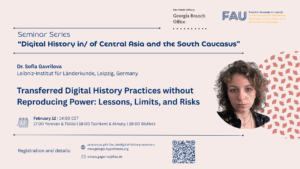 The first seminar will be held on February 12, 14:00 CET | 17:00 Yerevan & Tbilisi | 18:00 Tashkent & Almaty | 19:00 Bishkek online in Zoom.
Topic: Transferred Digital History Practices without Reproducing Power: Lessons, Limits, and Risks.
Invited expert: Dr. Sofia Gavrilova, Leibniz-Institut für Länderkunde, Leipzig, Germany.
Language: English.
Registration and Zoom-link: fau.zoom-x.de/meeting/register/4NeC_Z0LSOqfwOIXibug5A
Abstract
This talk interrogates the transfer of digital history practices not as a neutral process of methodological diffusion, but as a politically and epistemically charged act. Taking the Russian context as a case, it asks what – if anything – can be productively borrowed from Russian digital archives, online museums, and educational platforms, and where such transfers risk reproducing hierarchical and colonial modes of knowledge production.
Rather than treating digital tools as universally portable, the talk differentiates between technical infrastructures, interface design, narrative regimes, and institutional arrangements. It argues that while certain technical solutions may be adaptable, representational logics and narrative authorities are deeply embedded in specific historical, political, and imperial contexts. When detached from these conditions, they can silently reinscribe asymmetries of voice, visibility, and expertise.
The talk identifies key sites where contextual sensitivity becomes indispensable: the politics of source selection, visual grammars of legitimacy, claims to archival completeness, and the institutional positioning of digital history projects. It concludes by proposing a set of critical questions for reflexive reuse – aimed at enabling translation without extraction, and methodological learning without epistemic dominance.